
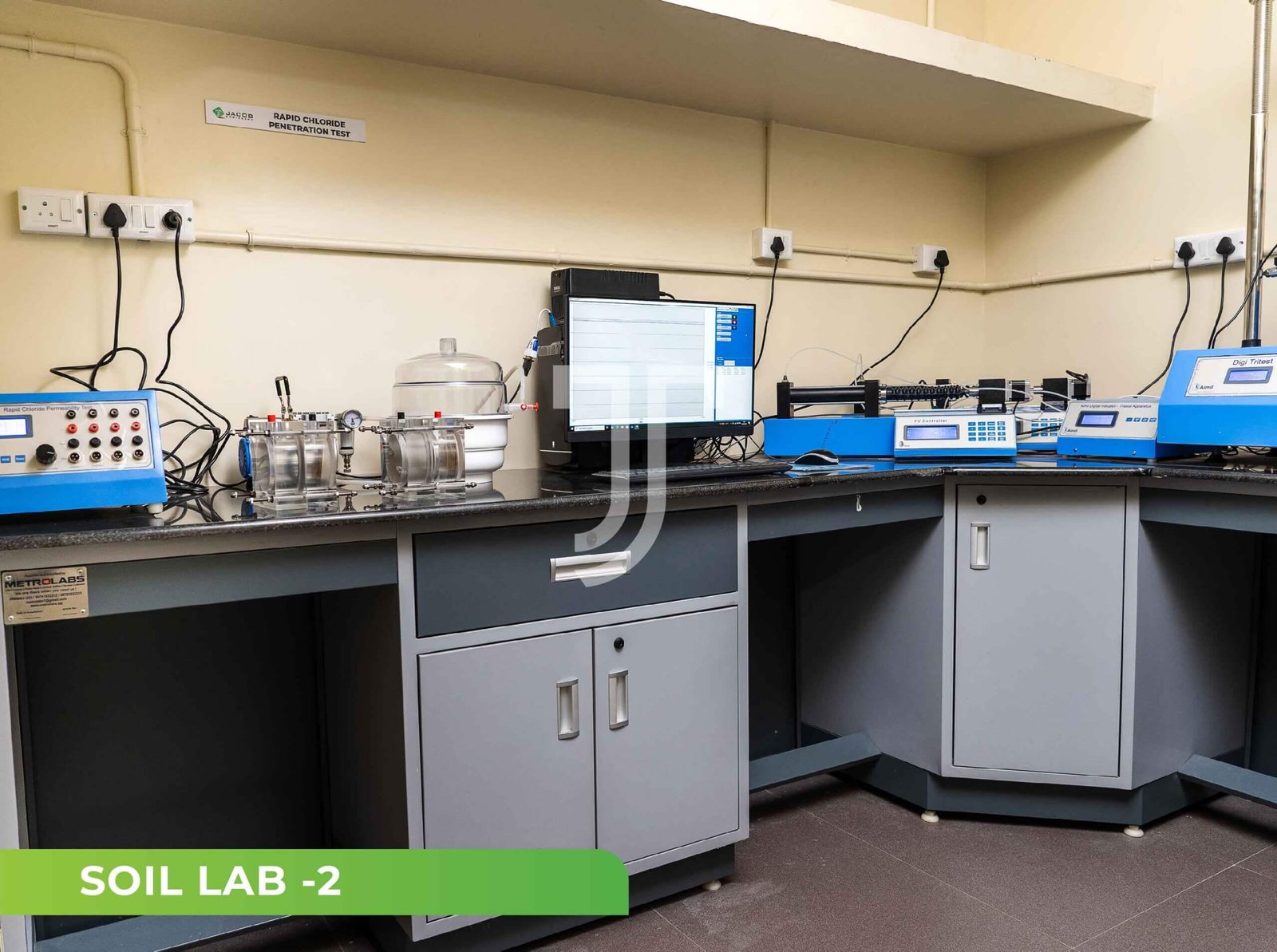
Material Testing Laboratory in Chennai
A complete guide to construction material testing, concrete testing, steel testing, aggregate testing, soil investigation and non-destructive testing for safer and more reliable construction.
Every strong building begins with materials that are capable of performing under real-world conditions. From concrete and reinforcement steel to aggregates, cement, bricks, blocks and soil, the quality of construction materials can influence the safety, durability and long-term performance of a structure.
This is why a professional material testing laboratory in Chennai plays an important role in modern construction. Laboratory testing provides engineers, contractors, architects, developers and project owners with measurable information about the properties and performance of construction materials.
Explore Jacob Engineers Material Testing Laboratory →
What Is a Material Testing Laboratory?
A material testing laboratory is a specialized facility where construction and engineering materials are evaluated using standardized testing procedures and appropriate laboratory equipment.
The purpose is to determine important physical, mechanical and chemical properties and establish whether a material is suitable for its intended application.
In construction projects, testing can help verify the quality of materials before they are incorporated into foundations, columns, beams, slabs, roads, industrial structures and infrastructure projects.
Why Is Construction Material Testing Important?
Construction materials may appear satisfactory visually while still having properties that do not meet project specifications. Laboratory testing provides objective information that can support engineering and quality-control decisions.
Material Quality
Testing helps determine whether construction materials meet specified quality and performance requirements.
Structural Reliability
Testing provides measurable information about materials that contribute to structural performance.
Early Detection
Testing can help identify unsuitable or inconsistent materials before construction progresses.
Quality Assurance
Test reports provide documented evidence that can support construction quality-control processes.
What Materials Are Tested in Chennai?
A comprehensive construction material testing laboratory can test a wide range of materials used in civil engineering and building projects.
| Construction Material | Common Testing Areas |
|---|---|
| Concrete | Compressive strength, durability, permeability and other relevant properties. |
| Steel & Couplers | Tensile strength, yield stress, elongation, bend and rebend testing. |
| Coarse Aggregates | Sieve analysis, crushing value, impact value, abrasion and specific gravity. |
| Fine Aggregates & Sand | Sieve analysis, silt content, water absorption and specific gravity. |
| Cement | Fineness, consistency, setting time, soundness and strength. |
| Bricks | Compressive strength, water absorption, dimensions and efflorescence. |
| AAC & Concrete Blocks | Compressive strength, density, water absorption and dimensional properties. |
| Tiles | Water absorption, breaking strength and dimensional characteristics. |
| Construction Water | pH, chlorides, sulphates and other relevant quality parameters. |
Concrete Testing Laboratory in Chennai
Concrete is one of the most widely used construction materials, and its performance can significantly influence the structural behaviour of a building or infrastructure project.
Concrete testing may include tests designed to evaluate strength, consistency, durability and other characteristics required by project specifications.
For projects requiring professional concrete testing in Chennai , working with an experienced laboratory can provide valuable quality-control information.
Steel Testing in Chennai
Reinforcement steel plays an important role in reinforced concrete structures. Its mechanical properties need to be appropriate for the intended structural application.
Steel testing can include tensile strength, yield stress, elongation, bend and rebend tests and other relevant evaluations depending on the material specification and applicable testing standard.
Aggregate and Sand Testing
Aggregates form a significant portion of concrete mixes. Their grading, strength, cleanliness and physical characteristics can influence concrete workability and performance.
A professional material testing laboratory in Chennai can conduct different tests on coarse and fine aggregates, including sieve analysis, specific gravity, water absorption, crushing value and impact value.
Brick, Block and AAC Block Testing
Masonry materials are used extensively in residential, commercial and industrial construction. Testing can help determine whether manufactured units meet specified requirements.
Depending on the material and applicable standard, testing may evaluate compressive strength, water absorption, density, dimensions and drying shrinkage.
Soil Testing and Geotechnical Investigation
Material testing is not limited to materials placed above ground. Understanding the engineering characteristics of soil is also important when designing foundations.
Soil testing in Chennai and geotechnical investigation can provide engineers with information about subsurface conditions and support foundation design decisions.
Depending on project requirements, investigations may involve borehole investigation, Standard Penetration Testing (SPT), soil classification and laboratory evaluation of soil properties.
Non-Destructive Testing for Existing Structures
Existing buildings and concrete structures may require investigation when there are concerns about deterioration, cracking, corrosion or structural performance.
Non-destructive testing (NDT) provides techniques for investigating aspects of existing structures while minimizing damage to structural components.
Rebound Hammer Test
Rebound hammer testing provides an indication of concrete surface hardness and can be used as part of concrete condition assessment.
Ultrasonic Pulse Velocity Test
UPV testing can help assess concrete uniformity and investigate potential internal discontinuities.
Carbonation Testing
Carbonation testing can help determine carbonation depth and support durability assessments of reinforced concrete structures.
Half Cell Potential Testing
Half-cell potential measurements can assist engineers in assessing the likelihood of reinforcement corrosion.
Rebar Locator and Cover Meter Testing
Reinforcement detection and cover measurement can help identify reinforcement location, spacing and concrete cover before repair, drilling or structural modification.
What Is an NABL Accredited Material Testing Laboratory?
Accreditation is an important consideration when selecting a professional testing laboratory.
An NABL accredited material testing laboratory in Chennai has been assessed for technical competence and relevant quality systems within its accredited scope.
Jacob Engineers' Structural and Material Testing Division provides material and structural testing services for construction and engineering requirements.
Why Choose a Third-Party Material Testing Laboratory?
Independent testing provides an additional layer of quality control between material suppliers, contractors, developers and project owners.
A third-party material testing laboratory in Chennai can independently evaluate construction materials and provide documented results for project quality-control processes.
This can be particularly valuable for residential developments, commercial buildings, industrial projects, infrastructure works and projects involving multiple material suppliers.
How to Choose the Right Material Testing Laboratory in Chennai
Selecting a laboratory should involve more than simply comparing prices. Consider technical capability, experience, equipment, accreditation status, testing scope and reporting quality.
- Check accreditation: Verify the laboratory's current accreditation status and scope.
- Verify testing capabilities: Ensure the laboratory performs the specific tests required for the project.
- Consider technical expertise: Review the laboratory's experience and technical team.
- Review test reports: Reports should clearly document samples, test methods and results.
- Consider project logistics: Sample collection and site-testing capabilities can be important for large projects.
- Check turnaround time: Testing schedules should align with project quality-control requirements.
Material Testing for Safer and More Reliable Construction
Quality construction is not based on appearance alone. Reliable engineering decisions require measurable information about the materials being used.
From concrete and reinforcement steel to aggregates, cement, bricks, blocks and soil, appropriate testing can provide valuable evidence for construction quality assurance.
For existing structures, non-destructive testing can provide additional information about concrete condition, reinforcement and potential deterioration.
Need Material Testing for Your Project?
Speak with Jacob Engineers about material testing, structural testing, geotechnical investigation and construction quality-control requirements.
Explore Material Testing ServicesFrequently Asked Questions
A material testing laboratory evaluates construction and engineering materials to determine their physical, mechanical and chemical properties and suitability for construction.
Material testing helps engineers and construction teams verify whether materials meet specified quality and performance requirements before they are used in a project.
Common construction materials include concrete, steel, cement, aggregates, sand, bricks, AAC blocks, concrete blocks, tiles, admixtures and construction water, depending on the laboratory's testing scope.
An NABL accredited laboratory has been assessed for technical competence and quality systems within its accredited scope. The current accreditation scope should be verified for the specific test required.
Engineering testing services can include methods such as rebound hammer, ultrasonic pulse velocity, carbonation, half-cell potential, pile integrity and reinforcement cover-meter testing.