
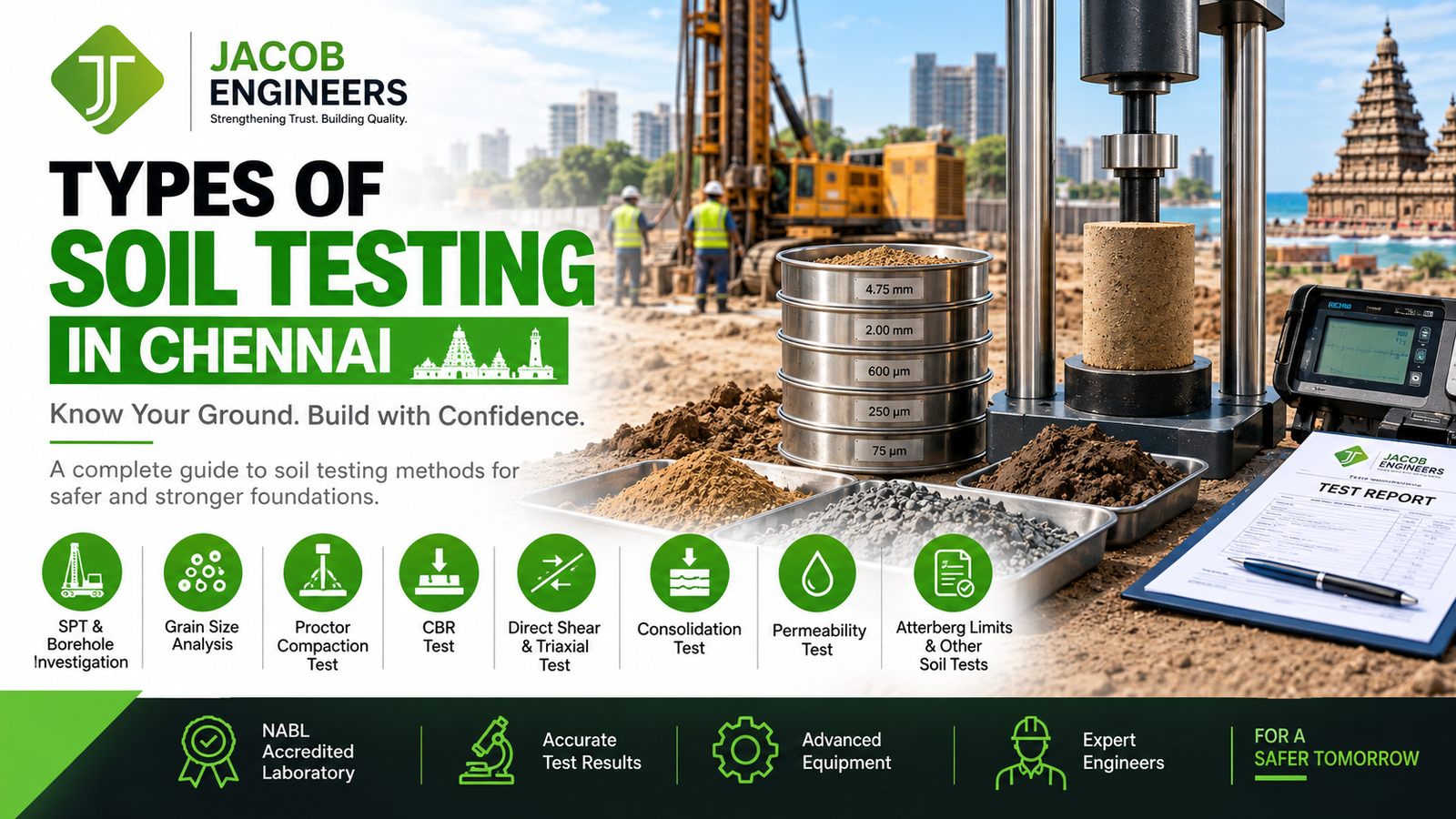
Types of Soil Testing in Chennai
A complete guide to soil testing methods used for construction, foundations, roads and infrastructure — including SPT, CBR, Proctor, direct shear, triaxial, consolidation, permeability, grain size and field density testing.
Before constructing a building, road, bridge, industrial facility or other major structure, engineers need to understand the ground on which it will be built.
Soil is not uniform. Its strength, density, moisture content, particle distribution, compressibility, permeability and engineering behaviour can vary significantly from one site to another.
This is why soil testing in Chennai is an important part of construction and geotechnical engineering.
Different projects require different tests. A foundation investigation may require SPT and soil classification, while a road project may place greater emphasis on CBR and compaction characteristics. Soft soils may require consolidation and shear-strength testing.
Explore Jacob Engineers Geotechnical Services →
Why Is Soil Testing Important Before Construction?
The foundation transfers structural loads into the ground. If the engineering properties of the soil are not adequately understood, foundation design and construction decisions may be based on insufficient information.
Soil testing can help engineers evaluate parameters relevant to:
- Foundation design
- Soil bearing and shear behaviour
- Settlement assessment
- Earthwork and compaction
- Road and pavement design
- Embankment construction
- Drainage and groundwater-related considerations
- Slope and ground stability
- Ground improvement decisions
Types of Soil Tests Used in Construction
There is no single soil test that can describe every engineering characteristic of a site. A geotechnical investigation normally combines appropriate field and laboratory tests according to the project requirements.
Standard Penetration Test
In-situ investigation of subsurface soil resistance and stratification.
Grain Size Analysis
Determines the distribution of gravel, sand, silt and clay-sized particles.
Proctor Compaction Test
Determines optimum moisture content and maximum dry density for the specified compaction procedure.
California Bearing Ratio
Evaluates penetration resistance of soil and pavement subgrade materials.
Direct Shear Test
Evaluates shear-strength characteristics under specified test conditions.
Triaxial Test
Determines shear-strength behaviour under controlled confining and loading conditions.
Consolidation Test
Evaluates compressibility and settlement behaviour of soil under loading.
Permeability Test
Evaluates the ability of soil to transmit water under specified conditions.
1. Standard Penetration Test (SPT) in Chennai
The Standard Penetration Test (SPT) is one of the widely used in-situ geotechnical investigation methods.
During an SPT investigation, a standard sampler is driven into the ground and the penetration resistance is recorded.
The resulting N-value is an important input used by geotechnical engineers when interpreting subsurface conditions and developing foundation recommendations.
SPT is particularly useful when the objective is to understand changes in soil strata with depth as part of a broader borehole investigation.
2. Grain Size Analysis of Soil
Grain size analysis determines the particle-size distribution of a soil sample.
Depending on the soil and required procedure, analysis may involve sieve methods for coarser particles and hydrometer analysis for finer particles.
The resulting particle-size distribution helps engineers classify soil and understand characteristics relevant to compaction, permeability and engineering behaviour.
3. Specific Gravity Test of Soil
The specific gravity of soil solids is an important index property used in geotechnical calculations.
It can be used along with other laboratory results to evaluate relationships between soil solids, water and air and to support calculations involving density and voids.
4. Soil Moisture and Water Content
The water content of soil can significantly influence its engineering behaviour.
Moisture content is particularly important when evaluating compaction, consistency, strength and consolidation behaviour.
It is therefore commonly determined alongside other soil laboratory tests.
5. Liquid Limit and Plastic Limit Tests
The Liquid Limit (LL) and Plastic Limit (PL) are part of the Atterberg limits used to describe the consistency behaviour of fine-grained soils.
These tests help engineers understand how the behaviour of clayey and silty soils changes with moisture content.
The results can contribute to soil classification and engineering assessment.
6. Free Swell Index Test
Some fine-grained soils can undergo significant volume changes when their moisture conditions change.
The Free Swell Index Test is used to assess the swelling tendency of soil under the specified laboratory procedure.
Swelling characteristics can be particularly relevant when assessing foundation and earthwork conditions involving expansive soils.
7. Swelling Pressure Test
Swelling pressure testing evaluates the pressure developed by an expansive soil when it attempts to swell under constrained conditions.
This information can be useful when assessing foundation and structural implications associated with expansive soil behaviour.
8. Proctor Compaction Test
The Proctor compaction test establishes the relationship between moisture content and dry density for a specified compaction procedure.
The test is used to determine:
- Optimum Moisture Content (OMC)
- Maximum Dry Density (MDD)
Both standard and modified Proctor procedures may be selected depending on the project requirements and applicable specifications.
Proctor testing is particularly important for earthworks, embankments, road construction and compaction control.
9. California Bearing Ratio (CBR) Test
The California Bearing Ratio (CBR) test is widely associated with pavement and road engineering.
It evaluates the penetration resistance of soil or pavement subgrade material under specified laboratory conditions.
CBR results can be used as part of pavement engineering and subgrade assessment.
Depending on the project, both laboratory CBR and field CBR investigations may be required.
10. Direct Shear Test
The Direct Shear Test is used to evaluate the shear-strength behaviour of soil under specified normal stress conditions.
Shear-strength information is important in many geotechnical engineering applications, including foundation, retaining structure and slope-related assessments.
11. Triaxial Shear Test
Triaxial testing is an advanced laboratory method used to investigate the shear-strength behaviour of soil under controlled confining pressure.
Depending on the test procedure, engineers can evaluate soil behaviour under different drainage and loading conditions.
Triaxial testing can be useful for projects requiring detailed geotechnical evaluation of soil strength.
12. Consolidation Test
The consolidation test evaluates how a soil compresses under applied loading over time.
This is particularly relevant for fine-grained and compressible soils where long-term settlement may be an important design consideration.
Consolidation parameters can help geotechnical engineers assess settlement behaviour and develop appropriate foundation recommendations.
13. Soil Permeability Test
Soil permeability describes the ability of water to flow through interconnected soil voids.
Permeability testing can be relevant to:
- Drainage design
- Retaining structures
- Earth dams and embankments
- Groundwater-related studies
- Geotechnical engineering analysis
14. Field Density Test
Field density testing is used to determine the in-situ density of compacted soil.
Jacob Engineers lists field density testing by:
- Core Cutter Method
- Sand Replacement Method
Field density results can be compared with laboratory compaction characteristics to evaluate the effectiveness of field compaction.
15. Field CBR Test
Field CBR testing provides an in-situ assessment of the penetration resistance of pavement subgrade or related soil conditions.
It can be useful when site conditions need to be evaluated directly rather than relying solely on laboratory-prepared specimens.
Soil Testing Methods and Their Applications
| Soil Test | What It Evaluates | Common Application |
|---|---|---|
| SPT | In-situ penetration resistance and subsurface conditions | Geotechnical investigation and foundation engineering |
| Grain Size Analysis | Particle-size distribution | Soil classification and engineering assessment |
| Specific Gravity | Density relationship of soil solids | Geotechnical calculations |
| Proctor Test | Moisture-density relationship | Earthwork and compaction |
| CBR | Subgrade penetration resistance | Roads and pavements |
| Direct Shear | Shear-strength characteristics | Foundations, slopes and retaining structures |
| Triaxial | Soil strength under controlled confinement | Advanced geotechnical analysis |
| Consolidation | Compressibility and settlement behaviour | Soft soil and settlement studies |
| Permeability | Water flow through soil | Drainage and groundwater-related engineering |
| Liquid & Plastic Limits | Fine-soil consistency behaviour | Soil classification |
| Field Density | In-situ compacted density | Earthwork and quality control |
| Swelling Pressure | Swelling behaviour under constrained conditions | Expansive soil assessment |
Soil Bearing Capacity Testing and Foundation Design
One of the most important questions in foundation engineering is how the ground will respond to the loads imposed by a structure.
The phrase soil bearing capacity test is commonly used to describe investigations and evaluations undertaken to establish suitable foundation design parameters.
In practice, bearing capacity assessment may involve a combination of field investigation, SPT data, laboratory shear-strength testing, soil classification and engineering interpretation.
The appropriate investigation depends on the site, structure, foundation system and applicable engineering requirements.
Soil Investigation for Building Foundations
A proper soil investigation in Chennai generally begins with understanding the project, site conditions and proposed foundation system.
Geotechnical investigation may include:
- Borehole drilling
- Standard Penetration Testing
- Soil sampling
- Laboratory soil testing
- Soil classification
- Engineering interpretation
- Foundation design recommendations
Jacob Engineers' published geotechnical service portfolio includes soil sampling and analysis, borehole drilling, SPT, slope stability analysis and foundation design recommendations.
Which Projects Need Soil Testing?
Houses & Apartments
Soil investigation can support foundation selection and design for residential buildings.
Commercial Buildings
Larger structures generally require appropriate investigation of subsurface conditions.
Industrial Projects
Soil and foundation investigations support facilities carrying significant structural and equipment loads.
Roads & Infrastructure
CBR, compaction, field density and geotechnical investigations can support infrastructure works.
Why Soil Testing Matters in Chennai
Chennai and its surrounding areas contain different geological and ground conditions. Soil characteristics can vary across locations and with depth.
For this reason, assuming that a particular soil condition exists across an entire locality is not a substitute for project-specific investigation.
A properly planned geotechnical investigation in Chennai provides site-specific information that can support engineering decisions.
How to Choose a Soil Testing Laboratory in Chennai
The quality of a geotechnical decision depends partly on the quality of the investigation and testing behind it.
- Check the testing scope: Make sure the laboratory can perform the specific tests required for the project.
- Check technical expertise: Geotechnical interpretation should be handled by appropriately experienced professionals.
- Review field capabilities: For foundation projects, field investigation and borehole capabilities can be important.
- Review laboratory facilities: Appropriate equipment and controlled test procedures are essential for reliable results.
- Check reporting: Reports should clearly document samples, methods, observations and results.
- Confirm accreditation where required: Verify the laboratory's current accreditation status and scope for the specific test.
Soil Testing Services by Jacob Engineers
Jacob Engineers provides soil testing and geotechnical engineering services for construction and infrastructure projects.
The company's published soil testing scope includes Standard and Modified Proctor, CBR, Direct Shear, Consolidation, Triaxial, Permeability, Swelling Pressure, grain-size analysis, Liquid and Plastic Limits, Free Swell, Specific Gravity and field density testing by Core Cutter and Sand Replacement methods.
Its geotechnical services also include soil sampling, borehole drilling, SPT, slope stability analysis and foundation design recommendations.
View Geotechnical Services →
Choose the Right Soil Test for Your Project
Soil testing is not about performing every possible laboratory test. It is about selecting the appropriate investigation and tests to answer the engineering questions relevant to a particular site and project.
SPT and borehole investigation can help understand subsurface conditions. Grain size and consistency tests help characterize soil. Proctor and field density tests support compaction control. CBR supports pavement and subgrade evaluation. Direct shear and triaxial testing provide information about shear strength. Consolidation helps evaluate compressibility and settlement behaviour. Permeability evaluates water-flow characteristics.
Together, these investigations and laboratory tests provide engineers with the technical information required to make better-informed geotechnical and foundation decisions.
Need Soil Testing in Chennai?
Talk to Jacob Engineers about soil testing, SPT, borehole investigation, CBR, Proctor, shear-strength testing, consolidation, permeability and other geotechnical requirements.
Explore Geotechnical ServicesFrequently Asked Questions About Soil Testing
Common soil tests include grain size analysis, specific gravity, moisture and density testing, Proctor compaction testing, CBR, direct shear, triaxial, consolidation, permeability, swelling pressure, free swell, liquid and plastic limits, field density testing and geotechnical field investigations such as SPT.
There is no single soil test suitable for every project. The required tests depend on soil type, project requirements, foundation system, loading conditions and applicable engineering standards.
The Standard Penetration Test is an in-situ geotechnical investigation method used to obtain information about subsurface soil conditions and penetration resistance.
The California Bearing Ratio test evaluates penetration resistance of soil and pavement subgrade materials and is widely used in pavement and road engineering.
The Proctor test determines the relationship between moisture content and dry density of soil and is used to establish optimum moisture content and maximum dry density for the specified compaction procedure.
Soil testing provides engineering information about the ground that can support foundation design, earthwork, pavement design, compaction control, drainage considerations and assessment of soil behaviour.
Yes. Jacob Engineers provides soil testing and geotechnical investigation services including laboratory soil testing, Standard Penetration Testing and borehole investigation.