
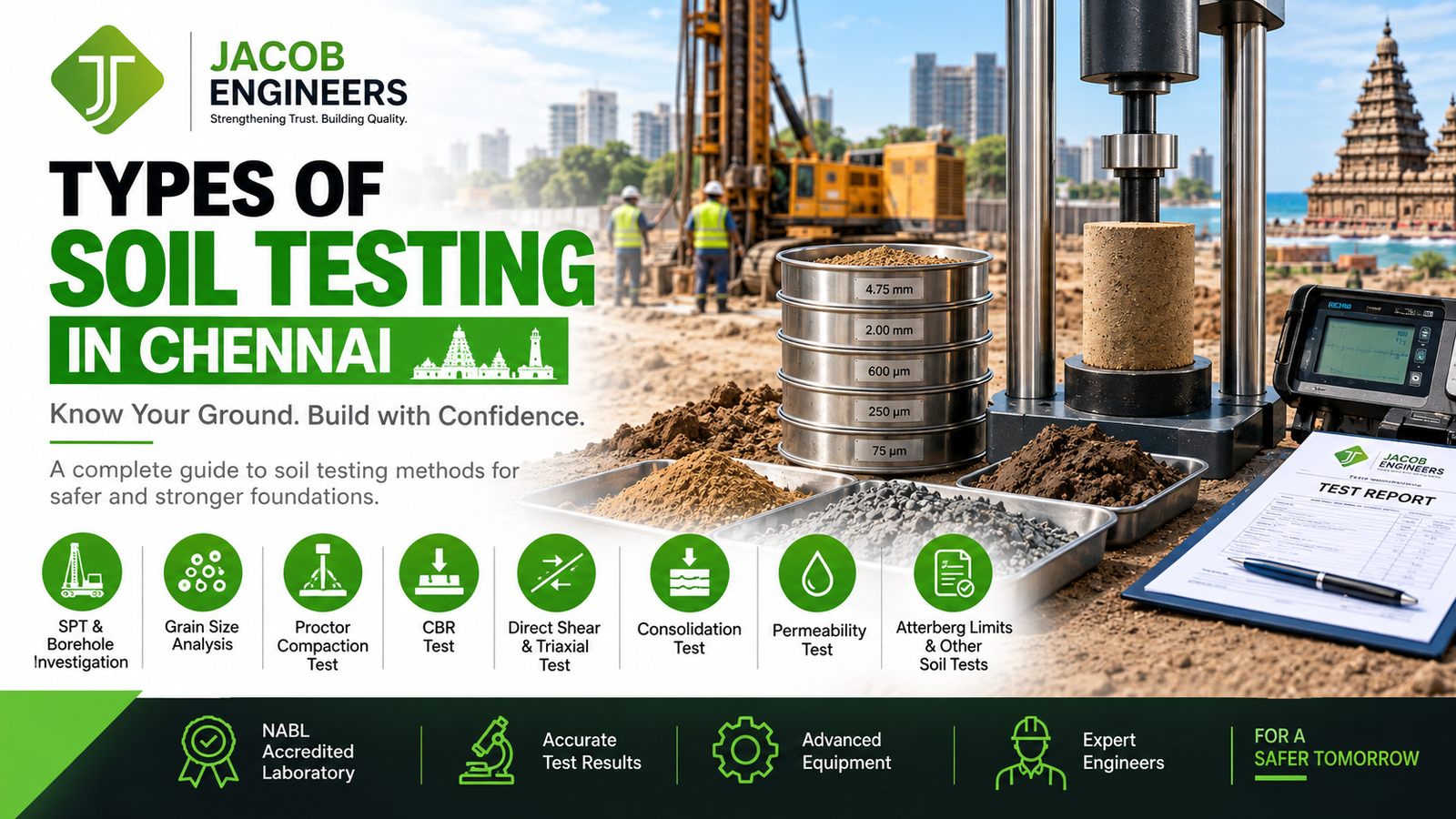
Soil SPT Test in Chennai: Complete Guide to Standard Penetration Testing
A soil SPT test in Chennai is an important part of geotechnical investigation for understanding the subsurface conditions beneath a proposed construction site. The Standard Penetration Test (SPT) provides field data about soil resistance and helps engineers evaluate ground conditions for foundation planning.
Before designing a building, industrial structure, commercial complex, infrastructure project or other major civil engineering work, it is important to understand what exists below ground level. Soil may vary significantly with depth, and surface observations alone cannot provide sufficient information for foundation engineering.
SPT testing in Chennai is commonly incorporated into borehole-based geotechnical investigations to obtain subsurface information at different depths. The resulting data can be considered along with laboratory soil tests, groundwater observations and engineering analysis to develop appropriate foundation recommendations.
Table of Contents
- What Is the SPT Test?
- Why Is SPT Testing Important?
- How Is an SPT Test Conducted?
- What Is the SPT N-Value?
- How Are SPT Results Interpreted?
- SPT Test for Foundation Design
- Why SPT Testing Matters in Chennai
- Other Soil Tests Used with SPT
- Projects That May Require SPT Testing
- What Does an SPT Report Include?
- SPT Testing Services by Jacob Engineers
- Frequently Asked Questions
What Is the Standard Penetration Test?
The Standard Penetration Test (SPT) is an in-situ geotechnical investigation method used to assess the resistance and characteristics of subsurface soils. The test involves driving a split-barrel sampler into the ground and recording the number of hammer blows required for specified penetration.
SPT is particularly useful because it provides field measurements at different depths within a borehole. These observations can be combined with recovered soil samples and laboratory testing to develop a more complete understanding of subsurface conditions.
Jacob Engineers describes SPT as a widely used geotechnical investigation method for assessing the density and strength of subsurface soils.
Why Is Soil SPT Testing Important?
A foundation transfers structural loads into the ground. If the subsurface soil conditions are not properly understood, foundation performance can be affected by issues such as excessive settlement, inadequate bearing resistance or unexpected changes in soil strata.
A properly planned soil SPT test in Chennai can help generate site-specific information needed by geotechnical and structural engineers.
Key purposes of SPT testing include:
- Understanding subsurface soil resistance.
- Identifying changes in soil strata with depth.
- Supporting geotechnical soil classification.
- Providing SPT N-values for engineering interpretation.
- Supporting foundation bearing-capacity assessments.
- Providing information for settlement-related evaluations.
- Supporting shallow or deep foundation engineering studies.
- Assisting in geotechnical investigation reports.
- Supporting foundation design recommendations.
How Is an SPT Test Conducted?
SPT is normally performed as part of a borehole investigation. The precise field procedure should follow the applicable project specification and recognized testing standard.
The investigation is planned based on the project type, foundation requirements, site conditions and required exploration depth.
A borehole is advanced to the required depth using appropriate drilling equipment and procedures.
A suitable split-barrel sampler is positioned at the required test depth.
The sampler is driven into the soil using the specified hammer arrangement and field procedure.
The number of blows required for the specified penetration intervals is recorded.
The recovered material can be examined and described for relevant soil characteristics and classification.
SPT results are considered with borehole logs, groundwater observations and laboratory test data to develop engineering conclusions.
What Is the SPT N-Value?
One of the most commonly discussed results from an SPT investigation is the N-value. It represents the measured penetration resistance obtained during the specified portion of the test procedure.
Engineers use N-values as one part of the overall geotechnical interpretation. The meaning of an N-value depends on factors including soil type, groundwater conditions, test procedure, equipment and the applicable corrections or correlations used by the engineer.
How Are SPT Test Results Interpreted?
SPT results provide valuable field information, but geotechnical interpretation requires engineering judgment. The investigation team generally considers the SPT results together with the soil profile, recovered samples, groundwater conditions and laboratory test results.
| Investigation Information | Why It Matters |
|---|---|
| SPT N-value | Provides field penetration resistance information. |
| Soil Description | Helps identify and classify the encountered soil strata. |
| Depth | Shows how subsurface conditions change with elevation. |
| Groundwater | Provides important information for geotechnical assessment. |
| Laboratory Tests | Provides additional physical and engineering properties. |
| Borehole Log | Documents the subsurface profile and investigation observations. |
SPT Test for Foundation Design
Foundation design should be based on reliable information about the ground supporting the structure. SPT results can form an important part of the geotechnical investigation used to develop foundation recommendations.
Depending on the project and ground conditions, the investigation may help engineers evaluate whether the proposed foundation approach is suitable and whether additional analysis or testing is required.
Foundation-related applications may include:
- Assessment of subsurface soil conditions.
- Evaluation of soil resistance.
- Foundation bearing-capacity studies.
- Settlement assessment.
- Selection of suitable foundation systems.
- Support for foundation design recommendations.
- Investigation of variable soil strata.
- Geotechnical input for structural design.
For complex sites, SPT data may be supplemented by additional laboratory and field investigations before a final foundation solution is recommended.
Why Soil SPT Testing Matters in Chennai
Chennai contains a wide range of developed and developing construction environments. Subsurface conditions can vary from one location to another, which makes project-specific investigation important rather than relying solely on generalized assumptions about ground conditions.
A soil SPT test in Chennai can help identify variations in soil strata with depth and provide field data that can be evaluated alongside laboratory soil testing.
SPT investigation can be particularly useful for:
- Residential buildings.
- Apartment developments.
- Commercial buildings.
- Industrial structures.
- Warehouses.
- Institutional buildings.
- Infrastructure projects.
- Redevelopment projects.
- Large-scale foundations.
- Sites requiring detailed geotechnical investigation.
Other Soil Tests Used Alongside SPT
SPT is only one component of a complete geotechnical investigation. Depending on the project requirements, additional field and laboratory tests may be required to understand the engineering characteristics of the soil.
| Soil Test | Typical Purpose |
|---|---|
| Grain Size Analysis | Determines particle-size distribution and supports soil classification. |
| Specific Gravity | Determines the specific gravity of soil solids. |
| Atterberg Limits | Evaluates plastic and liquid limits of fine-grained soils. |
| Proctor Compaction Test | Determines moisture-density relationships for compaction assessment. |
| CBR Test | Evaluates subgrade strength for relevant pavement and ground applications. |
| Direct Shear Test | Provides shear strength parameters under specified test conditions. |
| Triaxial Test | Provides soil strength and stress-strain information under controlled conditions. |
| Consolidation Test | Helps evaluate compressibility and settlement characteristics. |
| Permeability Test | Determines the ability of soil to transmit water. |
| Field Density Test | Assesses in-situ soil density and compaction conditions. |
Jacob Engineers' published geotechnical service scope includes soil testing such as grain size analysis, specific gravity, OMC/MDD, CBR, direct shear, plastic and liquid limits, free swell and field density testing, in addition to SPT. :contentReference[oaicite:2]{index=2}
Which Construction Projects May Require SPT Testing?
The requirement for SPT depends on the project scope, foundation system, site conditions and applicable engineering requirements. A geotechnical professional can determine the appropriate investigation program.
Residential Construction
SPT investigation can provide subsurface information for houses, villas, apartments and residential developments where foundation conditions need to be evaluated.
Commercial Buildings
Offices, shopping facilities, hotels and other commercial developments may require detailed geotechnical information before foundation design.
Industrial Projects
Factories, warehouses, plants and heavy industrial facilities may require deeper and more detailed ground investigation depending on the structural loads and foundation configuration.
Infrastructure Projects
Infrastructure developments can involve extensive geotechnical investigation to understand soil conditions across multiple locations.
What Does an SPT Investigation Report Include?
The exact contents of a geotechnical report depend on the project and scope of investigation. A comprehensive report may document information such as:
- Project and site information.
- Borehole identification and location.
- Depth of investigation.
- Subsurface soil descriptions.
- SPT blow counts and N-values.
- Borehole logs.
- Groundwater observations where applicable.
- Laboratory soil test results.
- Interpretation of geotechnical data.
- Foundation-related recommendations where within the project scope.
SPT Test vs. Laboratory Soil Testing
A common misconception is that an SPT test replaces all other soil testing. In reality, SPT and laboratory testing serve different purposes and can complement each other.
| SPT Investigation | Laboratory Soil Testing |
|---|---|
| Performed in the field. | Performed on collected soil samples. |
| Provides penetration resistance information. | Determines specific physical and engineering properties. |
| Provides information at different borehole depths. | Provides controlled test results for selected samples. |
| Useful for developing subsurface profiles. | Useful for detailed soil characterization. |
A properly planned investigation considers the project requirements and determines which combination of field and laboratory tests is appropriate.
How to Choose an SPT Testing Company in Chennai
Selecting the right geotechnical testing provider is important because foundation decisions depend on the quality of the investigation and interpretation.
- Check the provider's geotechnical investigation experience.
- Confirm the scope of SPT and borehole investigation services.
- Review available laboratory soil testing capabilities.
- Check whether detailed investigation reports are provided.
- Ensure field data is properly documented.
- Consider the qualifications and experience of the technical team.
- Choose a provider capable of coordinating field and laboratory investigations.
- Discuss the project requirements before finalizing the investigation scope.
Soil SPT Test in Chennai by Jacob Engineers
Jacob Engineers provides geotechnical investigation and soil testing services for construction and infrastructure projects. Its published geotechnical service scope includes the Standard Penetration Test, borehole investigation, soil classification, bearing-capacity evaluation and foundation recommendations. :contentReference[oaicite:3]{index=3}
The company also provides a broader range of soil and geotechnical testing services, allowing field investigation data to be considered together with laboratory soil test results where required.
Jacob Engineers' Geotechnical Capabilities Include:
- Standard Penetration Test (SPT)
- Borehole Investigation
- Soil Sampling and Analysis
- Grain Size Analysis
- Specific Gravity
- Optimum Moisture Content (OMC)
- Maximum Dry Density (MDD)
- California Bearing Ratio (CBR)
- Direct Shear Test
- Plastic & Liquid Limits
- Free Swell Index
- Field Density Testing
- Foundation Design Support
- Soil Bearing Capacity Evaluation
Jacob Engineers also operates a NABL-accredited testing laboratory under ISO/IEC 17025:2017, with its published material-testing scope covering soil and geotechnical testing services. :contentReference[oaicite:4]{index=4}
Need a Soil SPT Test in Chennai?
Planning a residential, commercial, industrial or infrastructure project? Contact Jacob Engineers to discuss your soil investigation and SPT testing requirements.
Get professional guidance on borehole investigation, SPT testing, laboratory soil testing and geotechnical assessment.
Contact Jacob EngineersFrequently Asked Questions About Soil SPT Testing in Chennai
1. What is a soil SPT test?
A soil SPT test, or Standard Penetration Test, is an in-situ geotechnical test used to obtain information about the resistance and characteristics of subsurface soil at different depths.
2. Why is an SPT test required before foundation construction?
SPT investigation can provide site-specific subsurface information that helps geotechnical and structural engineers evaluate ground conditions and develop appropriate foundation recommendations.
3. What is an SPT N-value?
The SPT N-value is a measure of penetration resistance obtained during the specified part of the Standard Penetration Test. Its engineering interpretation depends on the soil conditions, testing procedure and applicable corrections and correlations.
4. Is SPT the same as soil testing?
No. SPT is a field geotechnical investigation method. Laboratory soil tests such as grain size analysis, Atterberg limits, Proctor, consolidation and shear testing provide additional information about soil properties.
5. Does SPT determine soil bearing capacity?
SPT results can contribute to bearing-capacity assessment, but bearing-capacity evaluation should consider the complete geotechnical investigation, soil profile, foundation geometry, groundwater and appropriate engineering methods.
6. Does Jacob Engineers provide SPT testing in Chennai?
Yes. Jacob Engineers lists Standard Penetration Testing and borehole investigation among its geotechnical services in addition to laboratory soil testing and foundation-related assessment. :contentReference[oaicite:5]{index=5}
7. How can I contact Jacob Engineers for SPT testing?
Project owners, builders, contractors and consultants can contact Jacob Engineers through the official contact page to discuss their soil investigation requirements.
Build on Better Ground with Reliable Soil Investigation
Reliable foundation engineering starts with understanding the ground beneath the project. A properly planned SPT investigation can provide valuable field information for geotechnical evaluation and foundation planning.
Discuss Your Project With Jacob EngineersJacob Engineers provides structural engineering, geotechnical investigation, material testing and related engineering services for construction and infrastructure projects. Its published geotechnical services include SPT, borehole investigation, soil testing and foundation-related assessment.